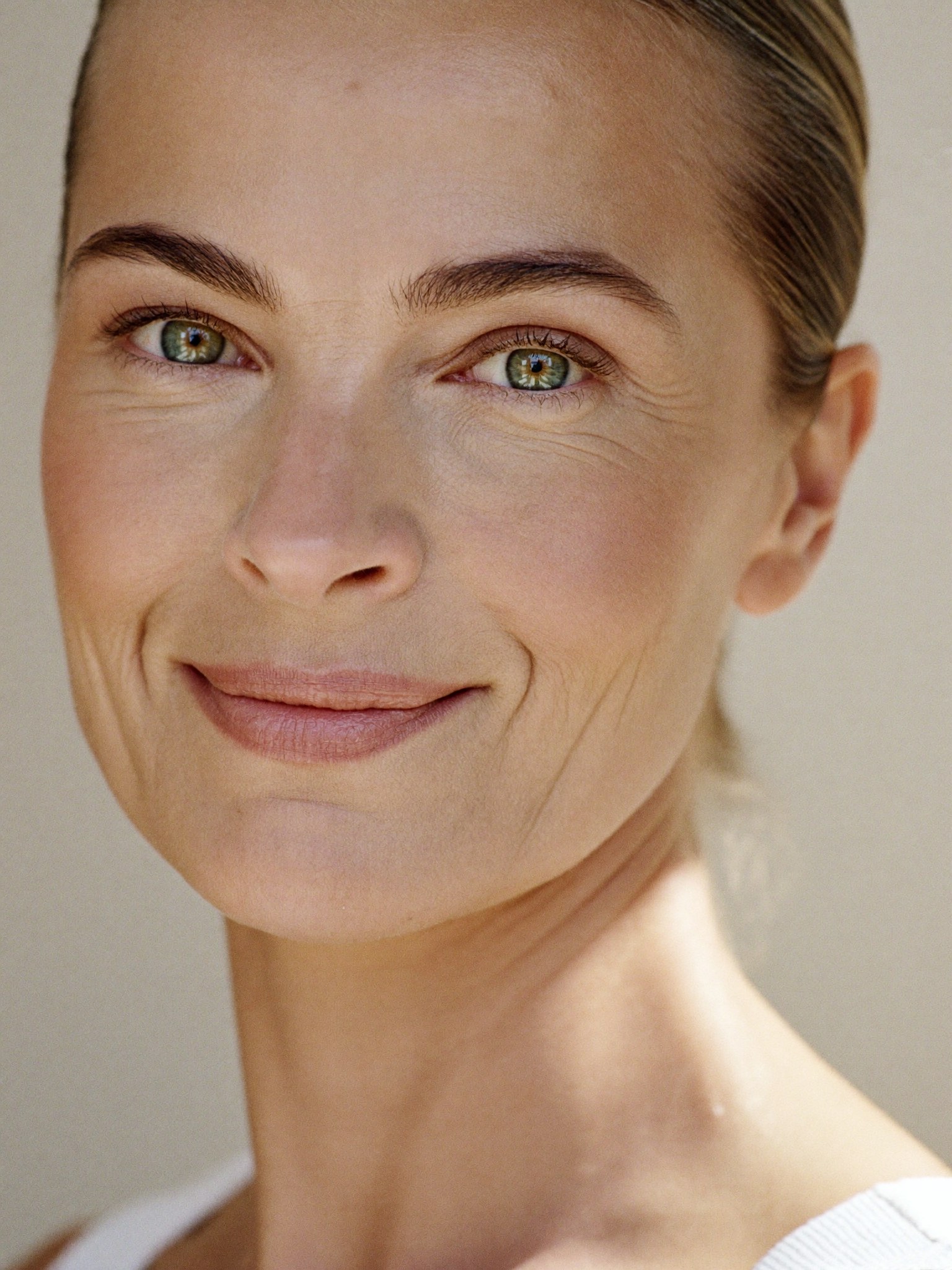
People keep telling you that you look tired — even when you’re not? Often it begins at the eyes: hooded or heavy upper eyelids are one of the first places aging quietly shows. A conservative, fat-preserving eyelid refresh — with a specialist — opens the eye and lifts the tiredness, while still looking entirely like you. No full facelift. See if you’re a candidate.
Double board-certifiedOculoplastic fellowship — the eyesA fat-preserving techniqueBy private consultation
Open, rested eyes — planned to look like no surgery at all.
Double board-certified Facial Plastic & Reconstructive Surgery
Fellowship-trained — oculoplastic (eyelid) surgery
Accredited surgical facility
Author, The Art of the Rested Eye
Castle Connolly recognized
The Technique
Why a conservative eyelid refresh looks rested — and why “hollowed” happens.
The technique is the whole difference between eyes that look rested and eyes that look operated on. The eye area is delicate and unforgiving — a millimetre matters — so it is worth understanding before you ever choose a surgeon.
The older way
Removing skin — and scooping fat
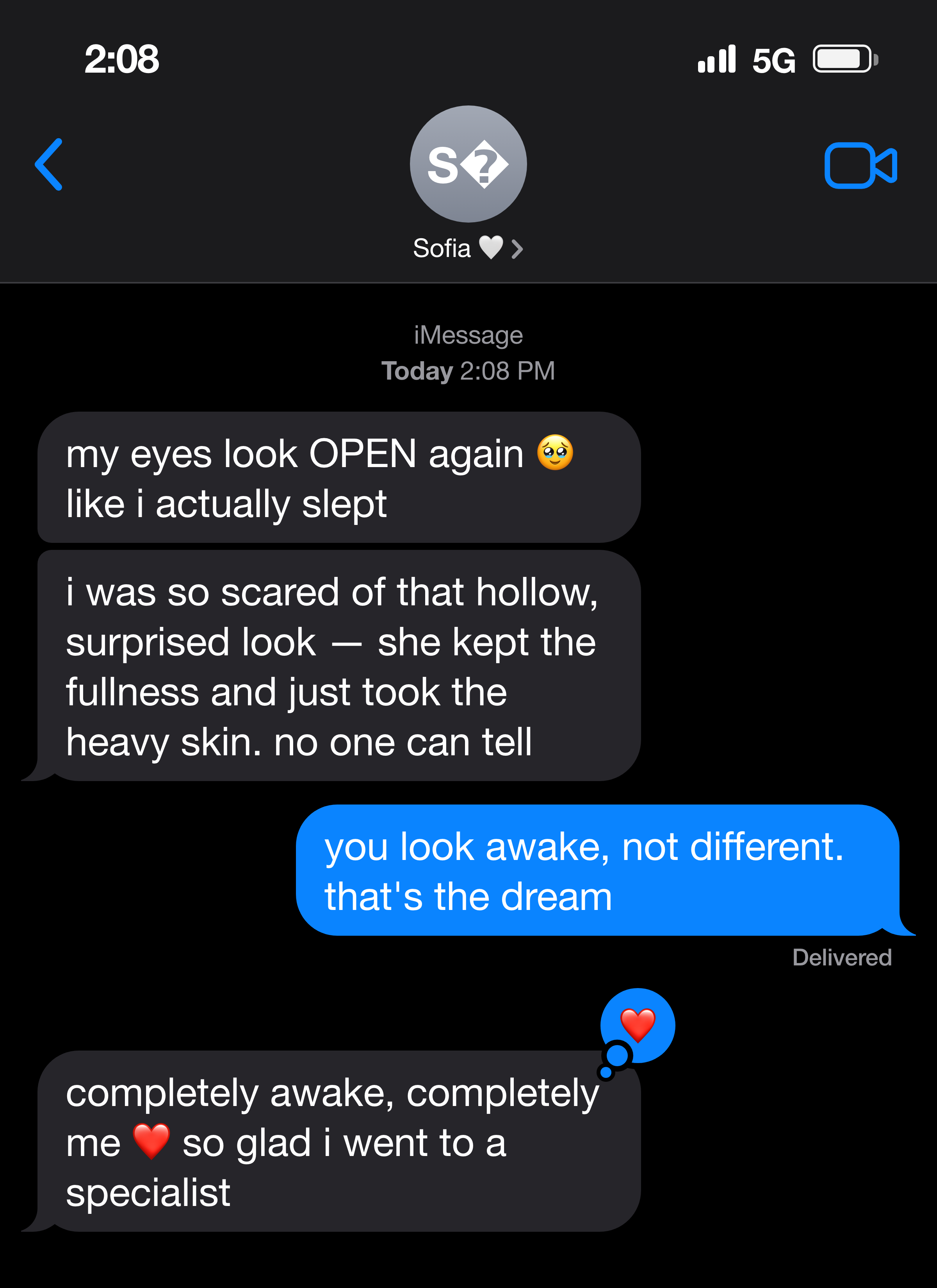
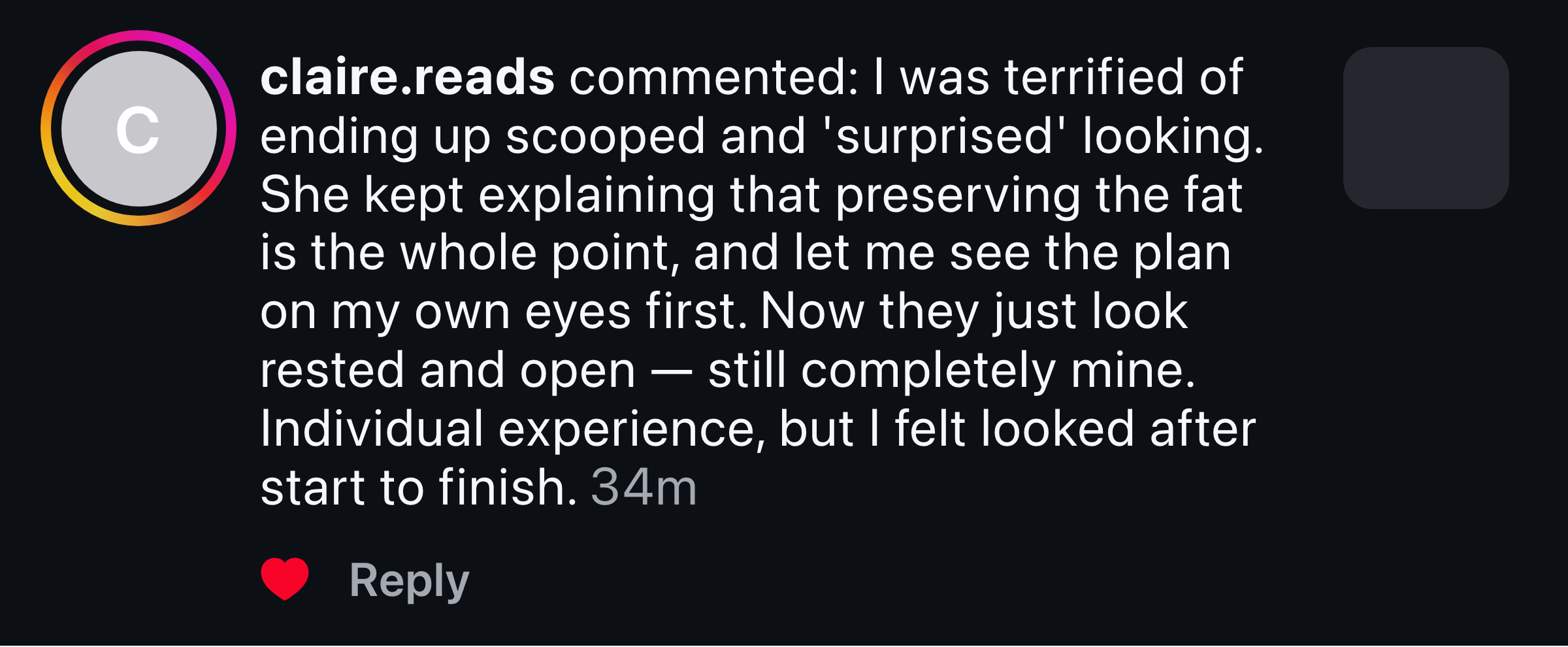
A more aggressive, older approach removes upper-lid skin and also scoops out the fat behind it. Take too much, and the eye can look hollow, skeletal, or permanently “surprised” — the operated, over-done look people quietly dread. Once fat is gone, it is hard to put back.
The specialist way
Removing only the excess, preserving the fullness
A conservative, fat-preserving upper blepharoplasty removes only the redundant skin that hoods the eye, and preserves or gently repositions the fat that keeps the eye full. So the eye simply looks open and rested — not emptied. It is real, precise surgery around a delicate area, with a real recovery, and it wants a specialist’s hand.
The eye isn’t emptied. It’s un-tired — the skin that hoods it is eased away, and the fullness that makes it yours is kept.
The diagnostic
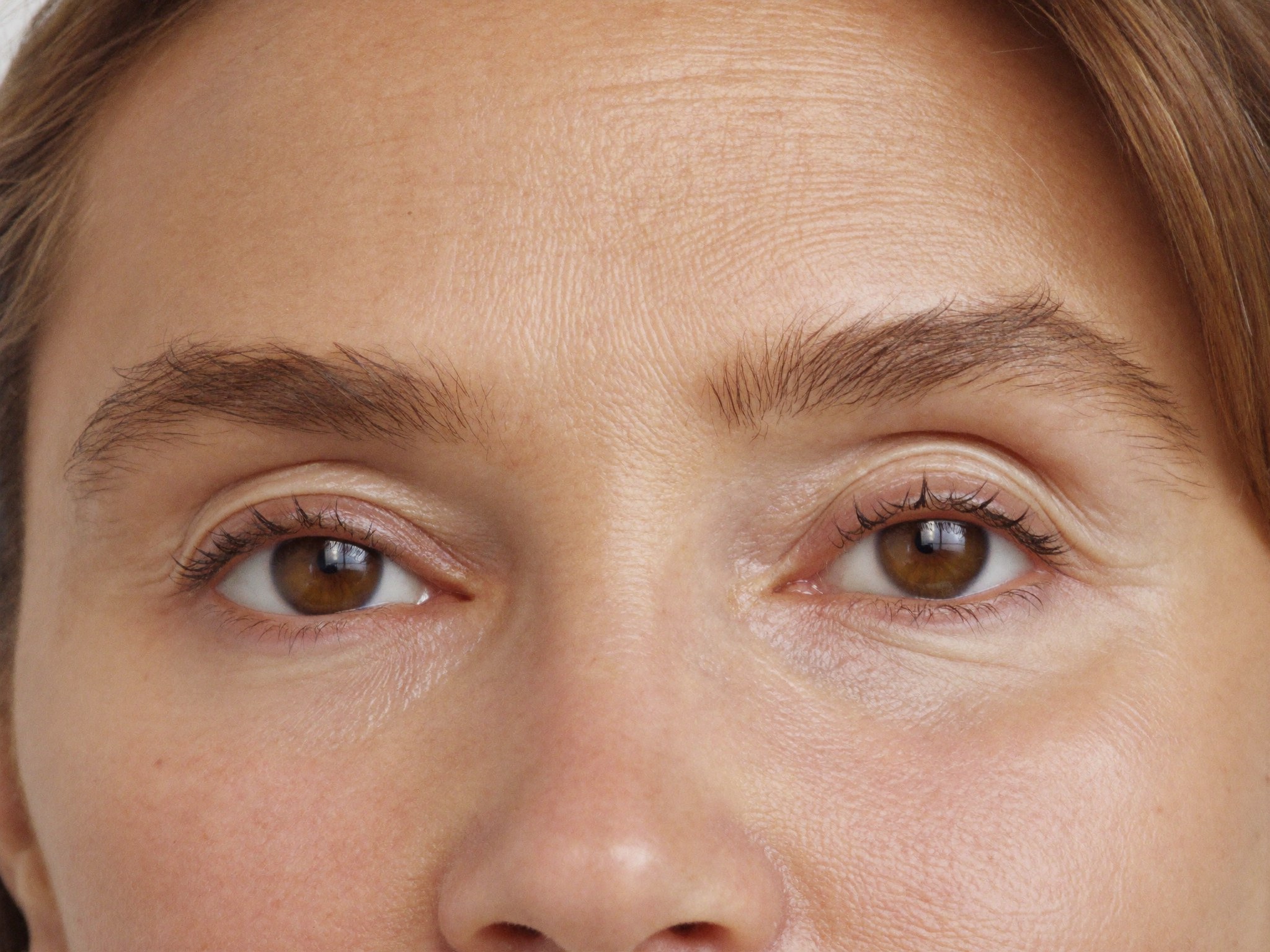
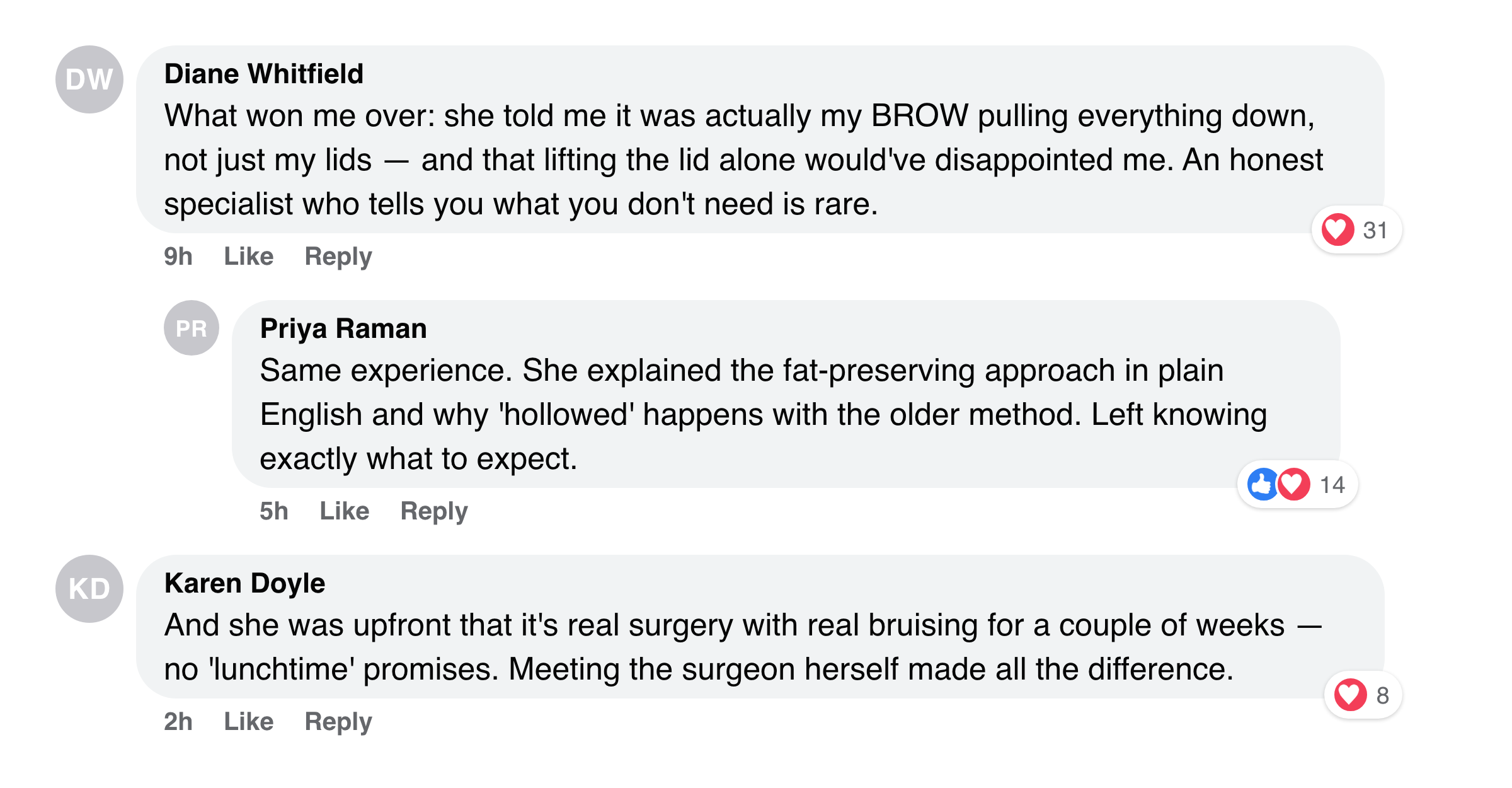
“You look tired.” But is it your lids — or your brow?
The heaviness over a tired-looking eye comes from one of two places — and they call for very different plans. Telling them apart, before anyone touches anything, is the whole point of seeing a specialist. The assessment starts you on the right one.
It may be your lids
Heavy, hooded upper eyelids
When it is the lid skin itself that has loosened and begun to hood the eye, a conservative upper blepharoplasty eases away only the excess — and the eye opens.
Skin that rests on, or over, your lashes
Lids that feel heavy by the end of the day
Eyeliner or shadow that vanishes into the fold
It may be your brow
A quietly descending brow
Sometimes the lid looks heavy because the brow above it has dropped and is pressing down. Lifting the lid alone won’t fix that — and can even look wrong. The brow is the real answer here.
You raise your brows to “open” your eyes
The heaviness lives above the lid, not on it
A tired look that a lid procedure wouldn’t reach
Operate on the lid when the real driver is the brow, and the result disappoints. A specialist tells them apart first — and if the honest answer is your brow, or that surgery isn’t the right step yet, we’ll say so.
Meet your surgeon
Around the eyes, a millimetre shows. That is why you want a specialist.
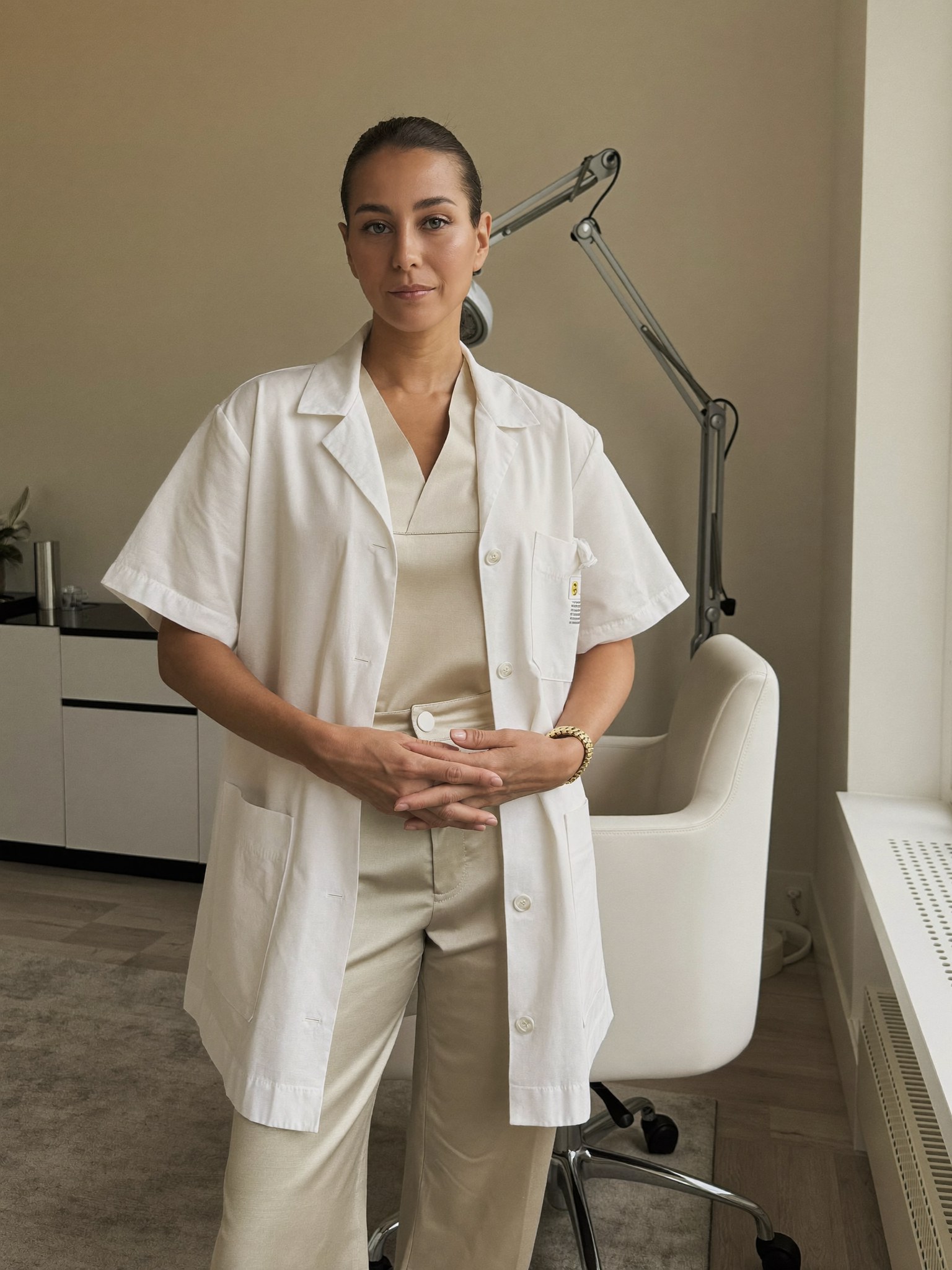
An eyelid result is only ever as natural as the hands that plan it — and the eye is the least forgiving area of the whole face. Every consultation is with Dr. Marchand herself, the person who will design your result and perform it.
Double board-certified in Facial Plastic & Reconstructive Surgery
Fellowship-trained in oculoplastic (eyelid) surgery
A conservative, fat-preserving approach to the upper lid
Author of The Art of the Rested Eye (demo title)
Operates only in an accredited surgical facility
Low-volume by design — one patient, one full plan, one surgeon
“My work around the eyes is judged by what no one notices. If people ask whether you slept well — not what you’ve had done — I’ve done my job.”
Dr. Élise Marchand
Before you decide
Your eyes, planned in person — conservatively, with a specialist.
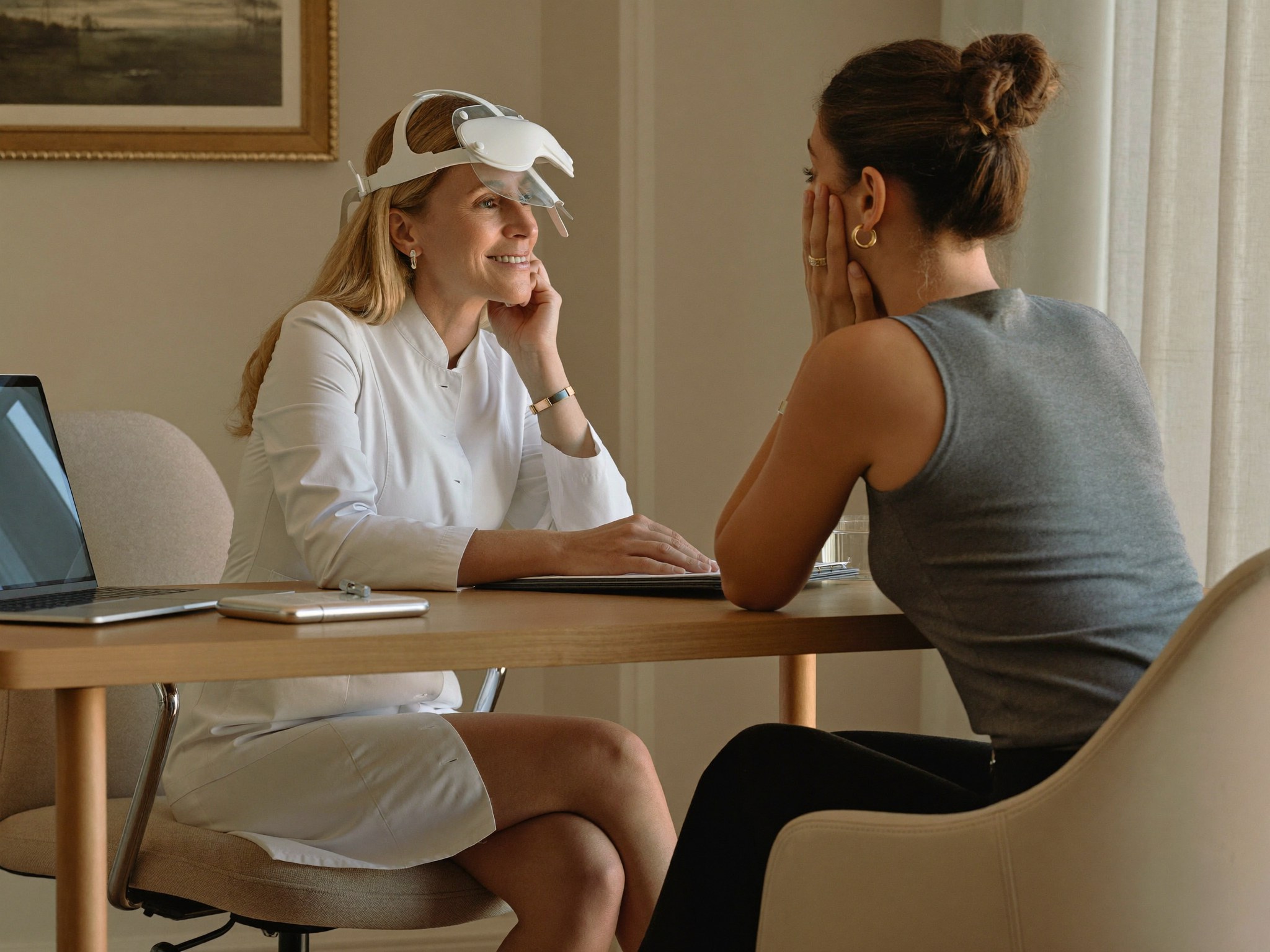
The hardest part of a decision like this is not knowing whether it will still look like you. At your consultation, Dr. Marchand assesses your lids and brow in person and designs the plan on your own eyes — measuring exactly what to ease away, and what to keep — so you can see the direction, and the restraint, before you commit to a single thing.
Measured, never scooped
The plan removes only the skin that hoods the eye and preserves the fat that keeps it full — so the result reads as rested, never hollow.
Lids or brow — decided first
She confirms whether the heaviness is your lids, your brow, or neither, before a single thing is planned.
No pressure, ever
A plan and an honest conversation, not a commitment. Many people take it home to think it over.
Any preview or planning imagery is a simulation used to plan and discuss your options — it is not a guarantee of your result. Individual results vary, and candidacy is confirmed only by a board-certified surgeon at your consultation.
Natural, never “done”
Rested, never hollowed. No one should be able to tell.
The fear almost everyone brings to eyelid surgery is the same: looking hollow, startled, or permanently “surprised” — that unmistakably operated eye. A conservative, fat-preserving approach is the answer to that fear, because it keeps the fullness that makes an eye look alive, and simply eases away the heaviness that reads as tired.
And if you’ve seen an over-done eyelid result on someone — scooped and skeletal — that is exactly what restraint is for. Natural is not luck. It is a technique, and a specialist who knows when to stop.
Still your eyes. Still your expression. Only, unmistakably, rested.
What we address
Every eye is different. So is every plan.
Upper eyelids
Hooded, heavy upper lids eased with a conservative, fat-preserving upper blepharoplasty — the “you look tired” correction, done with restraint.
Lower eyelids
Under-eye bags and puffiness, addressed by repositioning tissue rather than simply removing it — so the eye stays rested, never hollow.
Brow & forehead
When a quietly descending brow is the real reason the eyes look heavy, a brow assessment — because lifting the lid alone won’t reach it.
A combined eye refresh
When both the upper and lower lids are at play, one considered plan — combining only what the result genuinely requires.
When it’s not surgery yet
Sometimes the honest advice is to wait, or that it’s your brow, or that careful non-surgical steps are enough for now. We’ll tell you plainly.
When more than the eyes is at play
If a fuller rejuvenation would truly serve you better, we’ll say so — the eyes are often the right first step, not the only one.
Real results
The only question that matters: will it look natural on someone like me?
Drag to compare. Real, consented before-and-after imagery of the eye area lives here on the page — never on our ads — so you can judge the naturalness of a rested, un-hollowed result for yourself.
BeforeAfter
Open, rested eyes — still, unmistakably, her own.
Illustrative representative image for this demonstration — not a real patient, and not a real before-and-after pair. Your practice’s own consented patient photographs mount here at onboarding. Individual results vary and are never guaranteed.
A private eyelid assessment
Where to begin — considered privately.
A few unhurried questions, about a minute. At the end, a considered read on whether it’s your lids or your brow, your candidacy for a conservative eyelid refresh, and how we’d address what matters most to you — and an invitation to meet your specialist privately. Nothing is decided until you do.
A considered pre-screen, before any consultation.
This takes about a minute. Your answers stay private and are used only to prepare a thoughtful recommendation for you. There are no wrong answers — and no prices here; fees are a private conversation, once a plan exists.
Question One
What would you most like to address?
Choose what matters most to you today. This is the question that shapes everything after it.
Refresh tired eyes (lids or brow)
Lift the jowls, jawline & neck
Reshape my nose
Restore lost facial volume
Overall facial rejuvenation
Not sure — help me decide
Question Two
What describes your main concern best?
A rough sense is plenty. The consultation confirms what is truly at play.
Hooded or heavy upper eyelids
Under-eye bags or puffiness
Sagging, jowls or a loose neck
Nasal shape and/or breathing
A hollow, gaunt or deflated look
Not sure
Question Three
Which age range are you in?
This simply helps set the right tone and expectations — every plan is individual.
Under 30
30–44
45–54
55–64
65 or older
Question Four
The look you have in mind?
There is no wrong answer — only what suits you.
Very natural and subtle — no one should be able to tell
Noticeably refreshed
Not sure yet
Question Five
What is your biggest hesitation?
Be honest — this is the one that lets us reassure you properly.
Looking pulled, overdone or “done”
Going under general anaesthesia
Losing what makes me look like me / my heritage
Downtime and recovery
Choosing the wrong surgeon
Question Six
Any prior facial surgery?
No — this would be my first
Yes — happy with it, considering more
Yes — I’d like to correct or revise a past result
Question Seven
A little about your health.
This helps us plan safely and honestly — nothing here rules you out on its own.
Non-smoker & generally healthy
I smoke, or recently quit
On blood thinners / significant medical history
Question Eight
How are you thinking about timing?
I feel ready — within 0–3 months
Within 3–6 months
6–12 months
Just researching, unhurried
One more, for the nose
What matters most for your nose?
Rhinoplasty is its own specialty — this points us to the right kind of plan.
Mostly the appearance / shape
Mostly breathing / function
Both shape and breathing
Refine it while keeping my ethnic features
Revise a previous nose surgery
Considering your answers…
Almost there
Where shall we send your considered read?
We will send your recommendation and, if you wish, arrange for you to meet Dr. Marchand privately to plan your eyes in person. A member of the practice follows up quietly — no pressure, and no prices by email.
Your considered recommendation
A board-certified facial-plastic surgeon confirms your candidacy at your complimentary private consultation.
Meet your eyelid specialist
A complimentary private consultation — by appointment, New York
Free, no-obligation consultation · select a time on the next step
Reserve Your Consultation
Choose a day and time that suits you.
Complimentary and no-obligation — about 30–45 minutes with Dr. Marchand, where she assesses your lids and brow and plans on your own eyes in person, by appointment in New York. Availability shown is illustrative for this demo.
Select a day
Select a time
Choose a day above to see available times.
Free & no-obligation · 18+ · Dr. Marchand’s coordinator will confirm by text and email. No surgery is booked at this step.
✓
You’re booked.
Dr. Marchand’s coordinator will confirm your private consultation by text and email shortly — no action needed from you until then.
What to expect next
A member of the practice confirms your appointment by text and email, usually within one business day.
A brief call beforehand to understand your goals and answer any early questions.
At the consultation: you meet Dr. Marchand herself, she assesses whether it’s your lids or your brow and plans on your own eyes, and you receive an honest read on your candidacy and a custom plan — including whether she believes you should proceed, wait, or not at all.
This reserves a complimentary, no-obligation consultation — not a surgical booking. Candidacy is confirmed by Dr. Marchand in person, for patients 18 and over. Facial plastic surgery is real elective surgery; individual results vary. You may reschedule or step back at any point.
What to expect over time
The real question for a decision like this: will it last?
For a considered choice, the honest answer matters more than any number — so here it is, plainly.
Long-lasting, by nature
An upper-eyelid refresh tends to last a very long time — many people find the excess skin doesn’t return for a decade or more, on average, and it is often something you never need to have done again. That is a stated average, not a promise; yours will vary.
It ages with you
You will keep aging naturally afterward — the refresh doesn’t stop the clock, it sets the tiredness back. Because nothing was over-removed, it softens the way a real face does.
It’s real surgery
Even a conservative eyelid refresh is real surgery — with anaesthesia (often local, for suitable candidates), visible eye bruising and a real recovery. Never a “lunchtime” procedure. A lasting, natural result is earned by restraint, not claimed.
We would rather tell you the honest truth of what to expect than a comfortable one. Candour is the whole point of a consultation — and fees, when the time comes, are a private conversation once a plan that fits you exists.
Your recovery
Honest about the recovery — because it’s real surgery, even at its lightest.
There is no “lunchtime eye-lift.” Eyelid recovery is lighter than a facelift — but it is real, and it comes with visible bruising. What there is, is a realistic timeline mapped to your life before you ever agree to a date. These are typical ranges, individual and never guaranteed.
The first week
Bruising, swelling, and rest
Fine sutures sit hidden in the natural lid crease and usually come out around days five to seven. There is visible bruising and swelling around the eyes in the first days — most people plan to stay in and rest for about a week.
Around two weeks
Presentable, with a little concealer
By roughly two weeks, most people feel comfortable back in public — the bruising fades and light makeup covers what remains. Everyone heals at their own pace, and yours is individual.
Anaesthesia · for suitable candidates
Often awake, under local
Upper-eyelid surgery is frequently performed awake under local anaesthesia for suitable candidates — a safer alternative to general anaesthesia for those who qualify. Your surgeon will tell you honestly whether it is right for you; it is not for everyone.
Over the following weeks
The last fine swelling settles
The eye looks good early, but the finest swelling keeps settling quietly for some weeks as the result refines into its natural, rested self. Worth the patience, and worth knowing up front.
Lighter than a facelift, but real. Typical ranges, never a guaranteed timeline.
Your journey
From first conversation to the settled result.
Step One
Meet your specialist
A private, complimentary consultation with Dr. Marchand herself — your goals, your questions, and an honest read on whether an eyelid refresh (or anything at all) is right for you.
Step Two
Lids or brow, decided
She examines your lids and brow in person, confirms what is actually driving the tiredness, and designs the plan on your own eyes.
Step Three
Your custom plan
A plan built for your eyes — what to ease away, what to preserve, the recovery, and what to expect over time, all laid out plainly.
Step Four
Surgery day
Performed by Dr. Marchand in an accredited surgical facility — often awake under local for suitable candidates — with a team you’ll have already met.
Step Five
Recovery & the settled result
Guided recovery on an honest timeline, and a result that settles into something that simply looks like a well-rested you.
Still your eyes
Refreshed, never a different face.
The goal with the eyes is never to change them — it is to keep exactly what makes them yours, and simply lift the tiredness that has settled on top. Your eye shape, your expression, the way you look when you smile: all of it stays. A conservative, fat-preserving approach is built around that idea, not against it.
And where heavy upper lids are genuinely obstructing your vision, we’re honest about it: that functional correction may be partly covered by insurance when it is medically indicated — we’ll help you check. We never disguise cosmetic work as medical, and we never promise coverage.
You should still look like you — just like you, after a good night’s sleep. That is the point, not a compromise.
A patient’s story
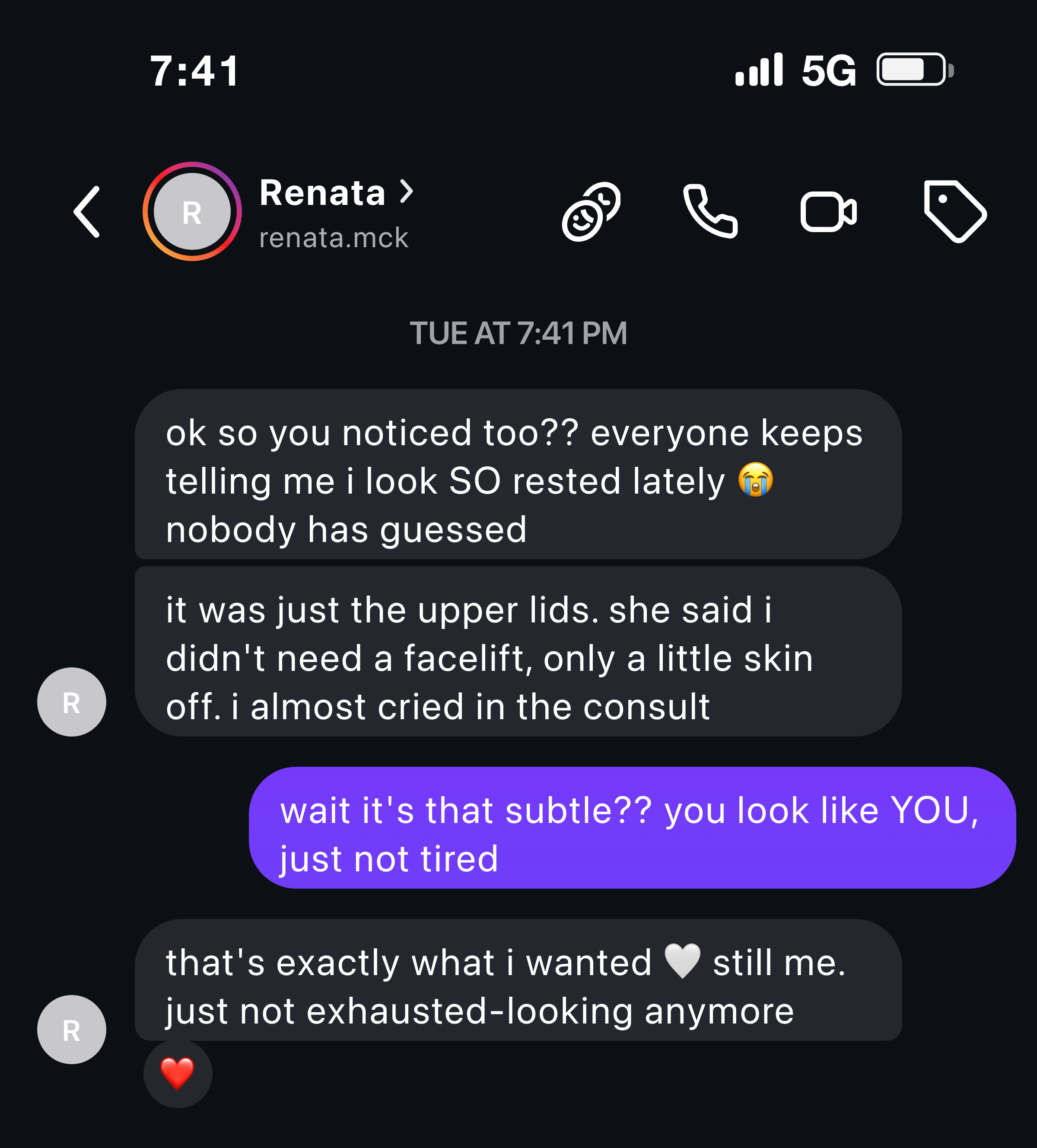
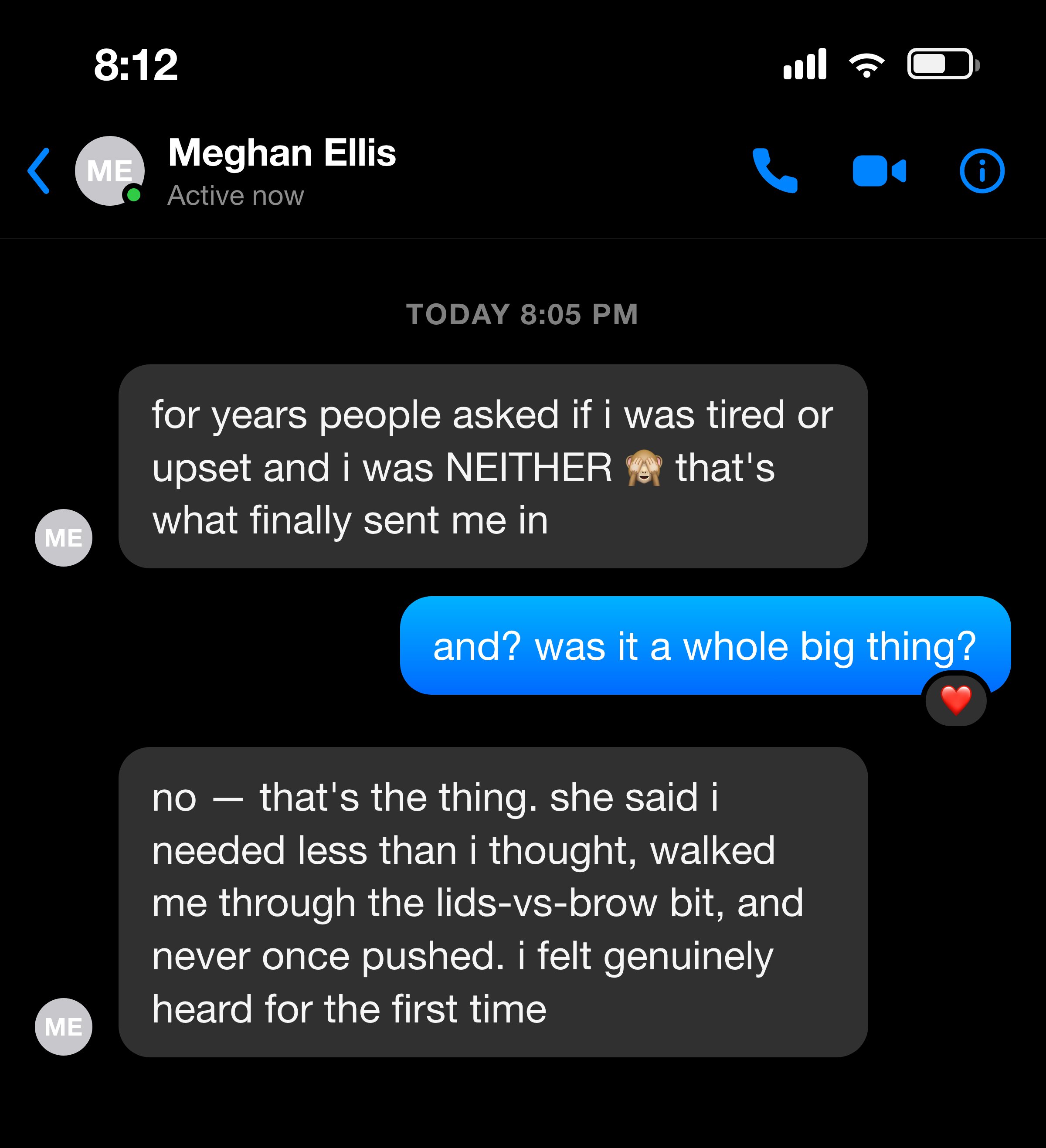
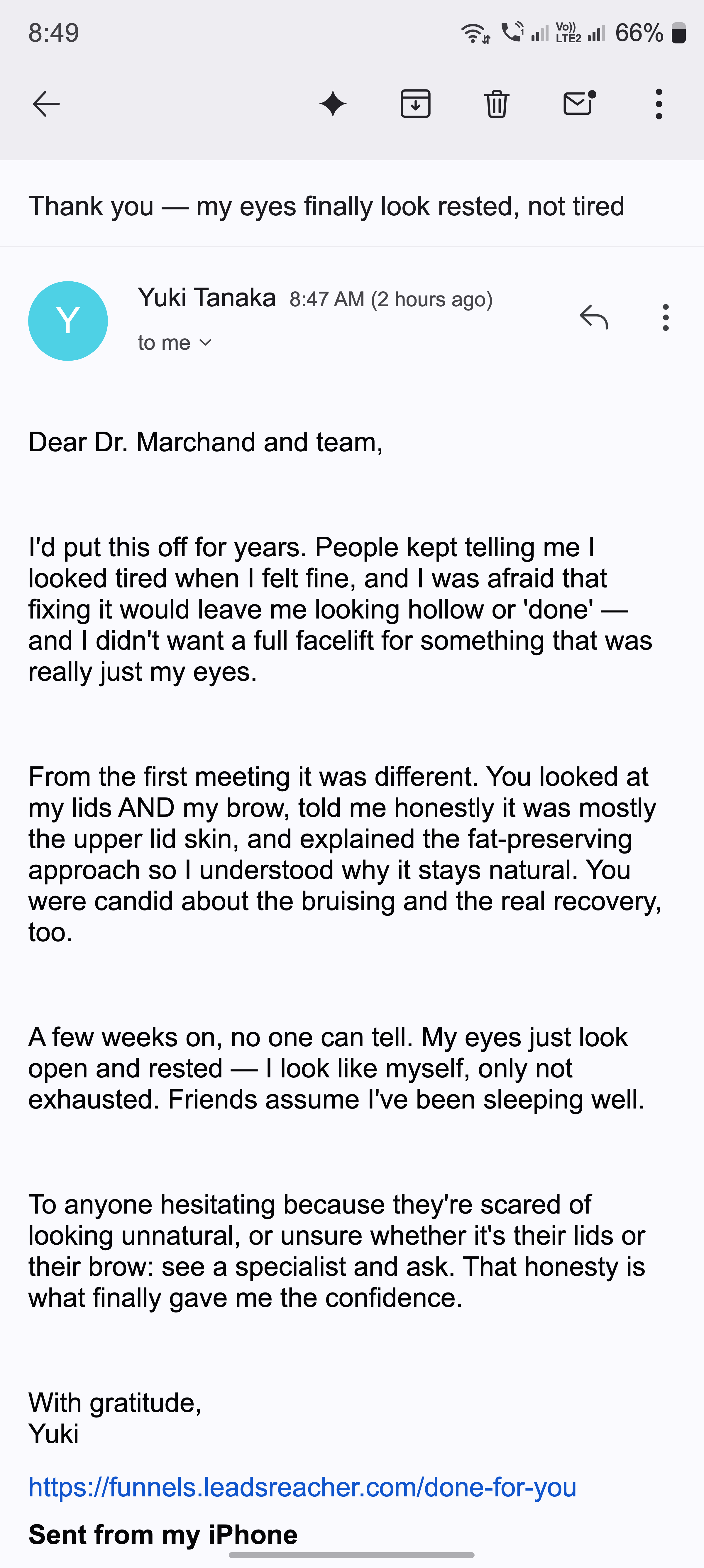
“For years people asked if I was tired, or upset — I was neither. She was the one who told me it was mostly my upper lids, not my brow, and that a little was all I needed. A few weeks on, no one can tell. My eyes just look open again.”
The register that matters most in this decision isn’t a number. It’s people who look like themselves, only less tired — who were told honestly whether it was their lids or their brow, and who felt genuinely looked after.
Illustrative demo testimonials — replaced with the practice’s own verified reviews at onboarding
An honest consultation
We’ll tell you if it’s your brow — or if it’s nothing at all.
Your consultation is complimentary and private, with the specialist herself. A board-certified surgeon confirms whether it is your lids, your brow, or neither — and will tell you honestly if you’re not a candidate, or should wait, or need less than you came in for. That honesty is the whole reassurance. There is nothing to sell you here, and no number waiting to surprise you.
Board-certifiedOculoplastic specialistFree private consultationHonest guidance, or none at all
Questions, answered plainly
Eyelid surgery, honestly.
Will I look hollow or “surprised,” or natural?
Natural is the entire point of a conservative, fat-preserving approach. Because it removes only the redundant skin and keeps the fat that gives the eye its fullness, the eye looks open and rested rather than scooped or startled — the goal is that people ask if you slept well, not what you had done. It is positioning grounded in technique, not a no-risk promise: it’s still surgery.
Is it my lids, or my brow?
That is the most important question, and it is exactly what a specialist assessment answers. Sometimes the lid skin itself has loosened; sometimes a descending brow is pressing down and the lids only look heavy. Operating on the lid when the real driver is the brow disappoints — so we tell them apart before anything is planned, and if the honest answer is your brow (or neither), we’ll say so.
How long does an eyelid refresh last?
A long time — many people find the excess upper-lid skin doesn’t return for a decade or more, and often never need it done again. That is a stated average, not a guarantee. You keep aging naturally afterward; the refresh sets the tiredness back rather than stopping the clock, and your result is individual.
What is the recovery really like?
Lighter than a facelift, but real. Fine sutures in the lid crease usually come out around days five to seven; there is visible bruising and swelling around the eyes for the first days, and most people feel comfortable back in public around two weeks with a little concealer. The finest swelling settles over some weeks after that. These are typical ranges, mapped to your life beforehand — never guaranteed timelines, and never a “lunchtime” fix.
Do I have to go under general anaesthesia?
Often not. Upper-eyelid surgery is frequently performed awake under local anaesthesia for suitable candidates — a safer alternative to general anaesthesia for those who qualify. Whether it’s appropriate for you is decided honestly at your consultation; it is not right for everyone.
Will there be visible scars?
For an upper-lid refresh, the incision is hidden in the natural crease of the eyelid, where it settles and fades to be very difficult to see. Any surgery leaves some scar; Dr. Marchand will show you exactly where yours would be, honestly, before you decide.
Could any of this be covered by insurance?
Only in one honest situation: where heavy upper lids are genuinely obstructing part of your vision, that functional correction may be partly covered when it is medically indicated — and we’ll help you check, often with a simple visual-field test. A purely cosmetic refresh is not covered. We never promise coverage, and we never disguise cosmetic work as medical.
Am I too young — or too old — for this?
It’s about your lids, not a birthday. Heavy or hooded upper lids are one of the first places aging shows, so some people are candidates in their late thirties or forties, and others much later. You must be 18 or over, and a specialist will tell you honestly whether it’s the right step for you now.
What about the fees?
Fees are discussed privately at your consultation, once there is a plan that genuinely fits you — because the right plan comes first. There is nothing to quote on a page, and nothing waiting to surprise you: you’ll be told plainly, in person, when the time is right.
Begin
Meet your specialist. Refresh tired eyes.
Start with the private eyelid assessment, or request a complimentary consultation directly. You’ll meet Dr. Marchand herself, find out whether it’s your lids or your brow, and get honest guidance on what’s right for you — with no pressure.